
Day 1 - 30 Day AI Automation Challenge
Introduction to AI Automation


Welcome to Day 1 of the 30 Day AI Automation Challenge. I am thrilled to have you here.
Today sets the foundation for everything we will build. You will understand what AI automation really is and how to think about AI as a digital employee that works for you 24/7.
Today’s Focus
Introduction to AI automation
How automations are structured
AI workflows vs AI agents
The Anatomy of an Automation
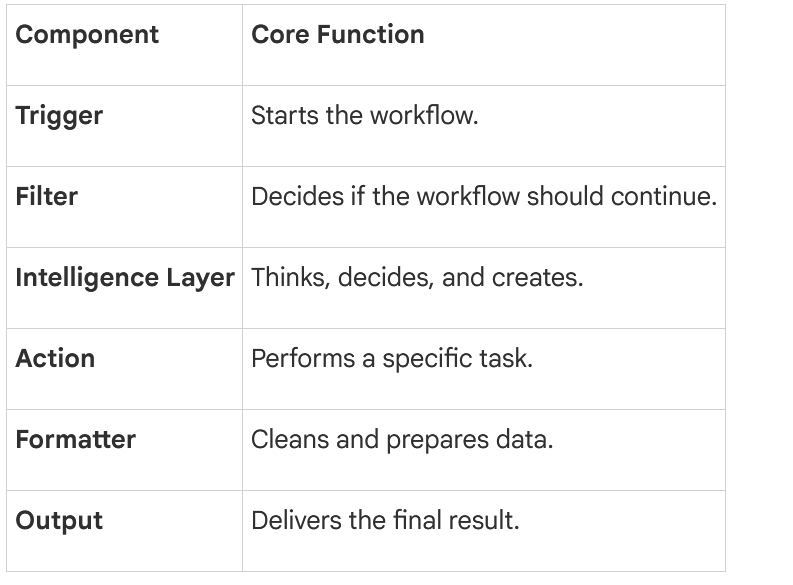
Understanding the core components that make up an automated process is essential. Every automation starts with a trigger and follows a sequence of actions.
LLMs, Workflows, and Agents
Large Language Models (LLMs) provide the intelligence, workflows provide the structure, and agents provide the autonomy to execute complex tasks.
Why We Use n8n
n8n is a powerful, fair-code tool that allows us to build complex automations with a visual interface while maintaining full control over our data.
Day 1 Note
To build powerful and cost-effective automations, it is strategically vital to first distinguish between two core concepts: AI Workflows and AI Agents. Understanding when to apply a structured, predictable process versus when to deploy an autonomous, decision-making agent is the cornerstone of effective system design. This foundational knowledge prevents costly errors and ensures you choose the right tool for every business challenge.
Core Concepts
No matter what you build, you'll be using the same six fundamental building blocks. Master these, and you can construct almost anything.
AI Agents
At its core, an AI Agent moves beyond the popular hype of a “digital employee.” The simplest and most accurate visualization is a three-step process:
Input → Large Language Model (LLM) → Output.
The agent receives information, uses an LLM to reason or “think” about it, and then produces a result.
The Anatomy of an AI Agent can be broken down into two primary components:
• Brain: This is the cognitive engine of the agent. It consists of a Large Language Model (e.g., models from OpenAI, Anthropic, or Google) that provides the reasoning and decision-making capabilities.
The brain also includes Memory, which can be short-term (retaining context within a single conversation) or long-term (storing information for future interactions).
• Instructions & Tools: These components guide the agent’s actions. Instructions define the agent’s role, goals, and rules of engagement. Tools are the specific actions the agent can perform, such as sending an email, conducting research, or updating a CRM.
Imagine you tell the agent, “Hey, can you help me send an email to John?” The agent uses its Brain to understand the request, checks its Memory for any relevant context about John, consults its Instructions on how to behave, and then selects its ‘send email’ Tool to execute the task. This entire process is how the components work together to turn a simple input into a useful output.
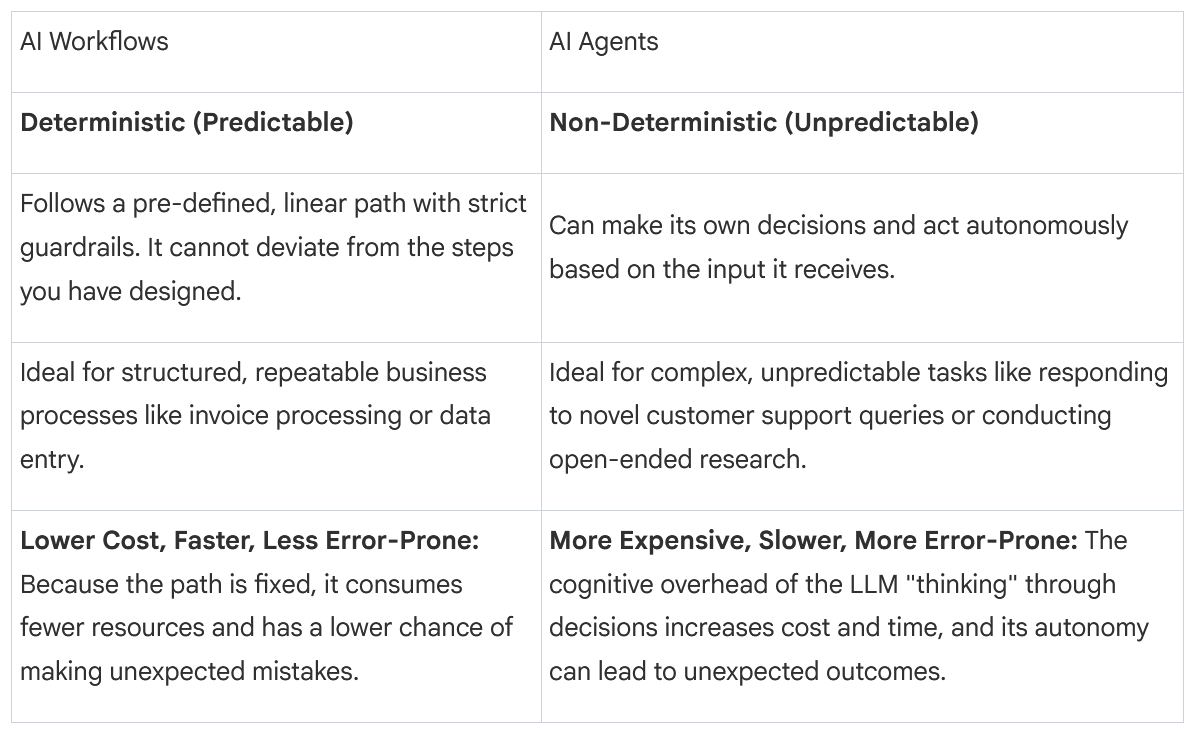
The key distinction lies in how a process executes, which we can compare in the table below.
AI Workflows vs AI Agents
Daily Takeaway
Your choice between building an AI workflow or an AI agent isn’t just a technical decision, it’s a strategic one that dictates cost, speed, and reliability. Mastering this unlocks the ability to build truly efficient automations, which we’ll see is a massive market opportunity tomorrow.
Watch Today’s Lesson
Today’s Task
Create your accountability document
Download Docker for your operating system
Write a short summary of what AI automation means to you
Respond to at least two other comments
Share your summary on social media. Video is recommended
Additional Resources
Tomorrow Preview
Tomorrow we move into setup. You will install n8n and understand the interface you will use throughout the challenge.
See you tomorrow,
Olalekan Adeeko

You are receiving this email because you joined the 30 Day AI Automation Challenge.